Attack on Titan Was Never Just About Titans
Attack on Titan is not just a story about Titans, war, or freedom. It is a story about perspective. At the beginning, we are taught to fear the Titans. Then we discover that the monsters are human. We meet Reiner, Annie, Bertholdt, Gabi and the people of Marley, and suddenly the enemy gets a childhood, a family and a reason to believe that they are the heroes of their own story. As the story moves from Paradis to Marley and eventually to the Rumbling, Attack on Titan keeps changing the angle.
There is a reason Attack on Titan stayed in people’s heads long after the final episode.
At first, it looks like a story about survival.
Humanity is trapped behind enormous walls. Titans roam outside. People are eaten. Soldiers die. A young boy named Eren wants to destroy every Titan standing between him and freedom.
It is a very simple emotional setup.
You know who to fear.
You know who to hate.
You know who you are supposed to root for.
And then Attack on Titan starts taking that certainty away from you.
The Titans become humans.
The enemy gets a childhood.
The people outside the walls get families.
The protagonist becomes the threat.
And suddenly, scenes you thought you understood years ago start meaning something completely different.
That is what makes Attack on Titan so interesting to me. Its biggest trick was never a plot twist. It was perspective.
The story kept changing the distance between us and its characters.
First, it made us afraid of something we knew almost nothing about.
Then it made us understand that thing.
Then it made us question the people we had been following all along.
And by the end, it leaves us with a much harder question than who was right or wrong.
It asks what happens when your idea of freedom requires someone else to lose theirs.
The Story First Teaches You Who the Monster Is
When Attack on Titan begins, Titans are almost impossible to understand.
They have no meaningful dialogue.
We do not know where they came from.
We do not know what their lives are like.
We do not know what they want.
We simply see them entering human spaces and destroying them.
The first major emotional experience of the series is not curiosity.
It is fear.
We see Shiganshina fall.
We see people running.
We see Eren lose his mother.
And because the story gives us almost no reason to understand the Titans, we process them as threats.
That matters.
Think about how easily we call something a monster when we only see its violence.
If someone destroys your home, kills people you love and gives you no explanation, you are not going to begin by asking about their childhood.
You are going to survive.
That is exactly where Attack on Titan places us.
We see the world from inside the walls.
We experience the Titans the same way Eren does.
They are the unknown thing outside.
And Eren's hatred grows from that uncertainty.
He does not only hate Titans.
He hates the fact that there is a world he cannot see.
The walls are therefore doing something much more interesting than keeping Titans outside.
They are also keeping information inside.
Eren knows that there is something beyond the walls, but he does not know what it is.
That gap between what he knows and what actually exists becomes one of the most important ideas in the entire story.
Because the audience has the same problem.
We are also trapped inside the walls of the information the story gives us.
And then Attack on Titan starts opening those walls.
The Monster Can Wear a Uniform
The first major crack in our understanding comes when we discover that the monster does not always look like a monster.
Annie is revealed to be the Female Titan.
Then comes Reiner.
Then Bertholdt.
And suddenly something becomes deeply uncomfortable.
The people we spent time with are connected to the destruction we experienced at the beginning.
But the important part is not simply that these characters were secretly Titans.
The bigger revelation is that we had already known them.
We had eaten with them.
Trained with them.
Watched them joke.
Watched them struggle.
Watched them become part of the same group as Eren, Mikasa and Armin.
The story did not need to create a completely new enemy.
It took someone we already knew and changed the context around them.
That is a very different kind of twist.
A normal twist gives you new information.
Attack on Titan often gives you old information from a new angle.
Reiner is a perfect example.
When we first see him, he is one of the soldiers fighting alongside Eren.
Later, we understand that he was one of the people sent to destroy Paradis.
The character did not suddenly become a different person because we learned the truth.
Our understanding of him changed.
And once that happens, earlier scenes start behaving differently in our memory.
A joke becomes suspicious.
A strange reaction suddenly makes sense.
A seemingly ordinary conversation carries a completely different weight.
That is one of the most impressive things Attack on Titan does with its storytelling.
It keeps moving the camera.
Then the Basement Changes Everything
For years, the basement is treated almost like a mythical destination.
Eren wants to know what his father was hiding.
The Scouts want answers.
The audience wants answers.
What are Titans?
What is outside the walls?
Why did Grisha behave the way he did?
What is the truth about the world?
And eventually, the basement opens.
But the biggest revelation is not simply that Marley exists.
It is what Marley does to the scale of the story.
Until this point, we have been thinking about humanity as the people inside the walls.
Now we discover that the people inside the walls are only one population in a much larger human world.
The world did not begin outside the walls.
It was already there.
It had countries.
Families.
Wars.
Politics.
History.
Fear.
And its own version of the truth.
The Titans also stop being simple monsters.
They become connected to history, inheritance, punishment and political conflict.
The story that began as survival horror quietly transforms into something much larger.
And Eren finally gets the answer he spent his childhood chasing.
There is a world outside.
But that creates a new problem.
Because freedom was supposed to begin at the ocean.
Instead, the ocean becomes a border.
The Ocean Is Not the End of the Story
One of the most beautiful moments in Attack on Titan is also one of its most unsettling.
The characters finally reach the ocean.
Armin is fascinated.
For him, this is the dream.
The thing they imagined for years is finally real.
The walls are behind them.
The ocean is in front of them.
But Eren does not look at the ocean the same way.
He looks beyond it.
Because he now knows that the other side contains people.
People who have never seen Paradis the way he sees it.
People who have their own fears.
Their own history.
Their own idea of who the monster is.
The dream has changed.
For Armin, the ocean represents discovery.
For Eren, it represents another boundary.
And somewhere across that boundary is an enemy.
This is where the story begins preparing us for its second major shift.
The camera is about to cross the sea.
Then the Enemy Gets a Childhood
Marley changes Attack on Titan because suddenly we are no longer looking at the enemy from a distance.
We are living with them.
We meet children.
We see families.
We see Reiner's mother.
We see Gabi.
We see Falco.
We see the Warrior candidates growing up inside a completely different version of the same history.
And something uncomfortable happens.
The enemy becomes human.
Not theoretically human.
Not in some abstract philosophical sense.
Human in the most ordinary way.
They eat.
They argue.
They laugh.
They worry about their families.
They want approval.
They are afraid of disappointing their parents.
They have dreams.
And most importantly, they believe their own story.
Reiner was not born knowing that the people on Paradis were devils.
He was taught that.
He grew up inside a system that gave him a particular version of history and rewarded him for believing it.
That does not make his actions harmless.
Understanding why someone did something is not the same as saying what they did was right.
Attack on Titan is very careful about that distinction.
It asks two separate questions.
Why did you do it?
And was it right?
Those questions are not interchangeable.
That distinction becomes especially important with Reiner.
His actions caused enormous suffering.
But once we understand the child who was turned into a soldier, the situation becomes harder to reduce to the simple idea of an evil person doing evil things.
The story has made us look closer.
And looking closer makes certainty harder.
Gabi Is Not Eren, But She Shows the Same Machine
Gabi is sometimes described as another version of Eren.
That comparison is useful, but only to a point.
Gabi is not Eren.
Her personality, experiences and decisions are different.
What they share is something more interesting.
They were both children given a story about who the enemy was.
They were both taught that certain people were dangerous.
They were both given a heroic purpose.
And both developed a strong sense of certainty from that environment.
Gabi believes the people on Paradis are devils.
Then she meets them.
And slowly, the people she was taught to fear stop being an abstract group.
They become individuals.
That is the uncomfortable part.
The story does not simply tell Gabi that she was stupid for believing what she believed.
It shows her what happens when an idea about a group comes face to face with actual people.
And that is one of Attack on Titan's recurring ideas.
Distance makes hatred easier.
The closer you get to someone, the harder it becomes to keep them inside a simple category.
But understanding someone does not erase what they have done.
It simply makes the situation more complicated.
Then Eren Walks Into the Enemy's City
This is where Attack on Titan performs one of its boldest perspective shifts.
Eren enters Marley.
For a while, he is not standing inside the Walls.
There are no Survey Corps uniforms around him.
No Titans walking through the distance.
No familiar battlefield.
There are streets.
Families.
Children.
Ordinary people waiting for a speech.
And then Eren meets Reiner.
Two characters who were once on completely different sides of the story sit together in a basement.
Reiner knows what Eren lost.
Eren knows what Reiner did.
Both understand that the person sitting across from them is connected to years of suffering.
Neither can return to who they were before.
And then the Tybur speech happens.
Eren transforms.
The camera sees him the way Marley sees him.
A terrifying figure appearing in the middle of a civilian crowd.
And suddenly, something clicks.
The visual language is exactly the same.
Earlier, we watched Titans arrive at human settlements and thought of them as monsters.
Now Eren arrives in a human settlement and causes destruction.
The side has changed.
The camera has changed.
The monster has changed.
Or perhaps our understanding of the monster has changed.
The Hero Becomes the Threat
This is where the story becomes difficult for the audience itself.
At the beginning, we made an emotional contract with Eren.
We were with him.
We saw his mother die.
We watched him join the Scouts.
We watched him fight.
We followed him to the basement.
We followed him to the ocean.
For years, the story trained us to understand Eren's anger.
Then the Rumbling begins.
And suddenly the person we followed for so long becomes the person the other characters need to stop.
That creates a different kind of question.
Not simply:
Is Eren right?
But:
When do we stop following a protagonist?
At what point does loyalty to a character become loyalty to an idea?
Eren's transformation is especially interesting because his final philosophy does not appear from nowhere.
It is an extreme version of something he already believed.
As a child, freedom meant getting beyond the walls.
Later, freedom becomes the removal of anything that can take that freedom away.
The word stays the same.
The scale changes.
And that difference matters.
Because if freedom means controlling every condition that could threaten you, eventually other people's freedom becomes an obstacle.
That is where Eren's idea of freedom becomes dangerous.
Zeke and Eren Are Looking at the Same Problem
Zeke and Eren disagree about what should happen next.
But there is an interesting similarity between their solutions.
Both believe the cycle of suffering has to end.
Both believe history will continue repeating itself if something drastic is not done.
Zeke wants to end the cycle through the euthanasia plan.
Eren chooses another path.
He wants to eliminate the external threat to Paradis.
Their methods and intentions are different.
Their scale is different.
But both are attempting to control the future because they fear what will happen if they do not.
And this is where Attack on Titan moves beyond a simple story about freedom versus oppression.
Sometimes the person trying to prevent future suffering can become obsessed with controlling the future.
Sometimes the desire to eliminate uncertainty can lead to the elimination of choice.
That is one of the most uncomfortable ideas in the story.
Because control can begin as protection.
The Rumbling Forces Us to Look From the Ground
The Rumbling is often remembered for its scale.
The Titans.
The destruction.
The spectacle.
But its real storytelling purpose is perspective.
At the beginning, we were inside the Walls.
Then we became soldiers.
Then we met Marley.
Now the story puts us on the ground beneath the Titans.
We see ordinary people running.
Families trying to survive.
Children who have no understanding of the political history that brought them there.
And suddenly, understanding Eren and judging his actions become two completely separate things.
We can understand why Eren believes he has to do this.
But understanding his reasoning does not erase the consequence.
The scale changes the moral question.
Freedom is no longer just something Eren feels inside himself.
It has become a physical condition being imposed on millions of other people.
They no longer get to choose their future.
And that is where the idea of freedom becomes deeply complicated.
Mikasa's Final Choice Is Bigger Than Love
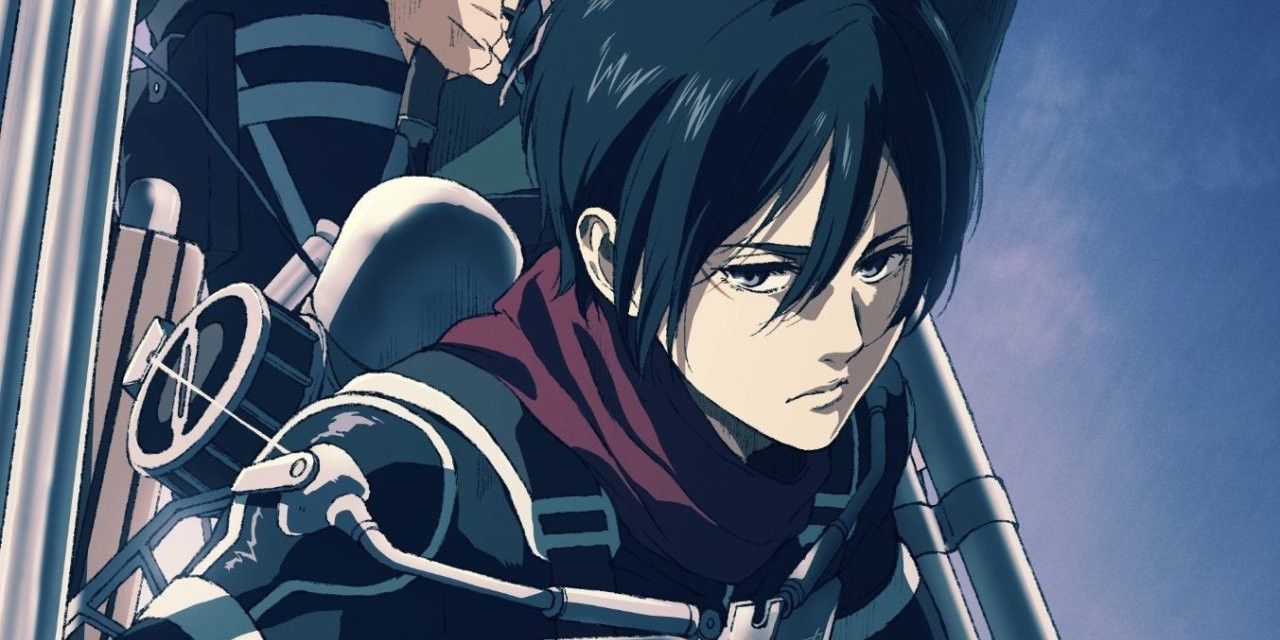
By the end, the story places one of its most important decisions in Mikasa's hands.
It would be easy to reduce her final choice to a love story.
But that makes it smaller than what the story is doing.
Mikasa loves Eren.
That is not in question.
The difficult part is whether loving someone means following them.
Eren has spent years trying to control the world in the name of freedom.
Mikasa has to decide whether her love for Eren requires obedience to Eren.
Those are not the same thing.
Her final choice forces a separation between love and submission.
She can love someone and still reject what they are doing.
She can understand someone and still stop them.
And that distinction connects back to the entire series.
Understanding is not absolution.
Perspective does not automatically erase responsibility.
Knowing someone's childhood does not make their actions disappear.
Knowing someone's fear does not make their choices harmless.
It simply means we can no longer pretend that the person is a monster and leave the conversation there.
Attack on Titan Kept Changing Sides
When you look at the entire story together, its structure becomes much clearer.
First, we see the Titan.
Then we see the human inside the Titan.
Then we see that person's childhood.
Then we see the childhood of the people they were taught to hate.
Then we see our hero through the eyes of those people.
And eventually, we are forced to decide what we think about the hero we once followed without hesitation.
That is why Attack on Titan's greatest trick is not that Titans are humans.
It is that the story keeps asking us to look again.
Look at the Titan.
Now look at the person.
Look at the enemy.
Now look at their childhood.
Look at the hero.
Now look at him from the enemy's perspective.
The facts do not necessarily change.
Our relationship with those facts does.
And that is why so many earlier scenes become heavier after later revelations.
The story does not erase the past.
It recontextualizes it.
Understanding Is Not the Same as Forgiving
This might be the most important distinction in the entire series.
Understanding Reiner does not mean Reiner was right.
Understanding Gabi does not mean her choices were harmless.
Understanding Eren does not mean his actions become justified.
In fact, Attack on Titan becomes more powerful when we refuse to collapse those things into one another.
You can understand someone and still hold them responsible.
You can understand why someone became who they are and still reject what they chose to do.
Perspective does not have to produce forgiveness.
Sometimes perspective produces responsibility.
Because once you have seen both sides, you can no longer comfortably hide behind the idea that only one group contains human beings.
And perhaps that is why the ocean matters so much.
When Eren was a child, he thought the world would begin where the wall ended.
When he finally reached that world, he discovered something completely different.
The world was already there.
It was full of people.
People with their own memories.
Their own fears.
Their own histories.
Their own ideas about freedom.
And every one of them believed they were looking at the story from the right side.
That is what Attack on Titan ultimately does.
It does not simply ask you to choose a side.
It makes you question what happens when you become completely certain that your side is the only side that matters.
And perhaps the hardest question the story leaves behind is not what freedom means.
It is this:
If your freedom requires destroying someone else's freedom, what exactly are you calling freedom?